
Running is an extremely popular activity in the United States and abroad. Because it does not require any additional equipment, it often makes for an inexpensive hobby that can help individuals lose weight and stay healthy. Depending on the type of running, this activity has the potential to both help and hurt the body.
3 Basic Types of Running
Regardless of the type of running, the health benefits are well documented. Runners can improve cardiovascular health, gain muscle, burn calories and boost energy. While many people assume there are two types of running: sprints and marathons, these are actually only two categories.
Base Run
A base run is a short-distance run. Runners use their own natural pace and do not focus on speed or agility. A base run is not competitive or challenging and is designed for a daily workout. Base runs are usually part of a weekly schedule for marathon runners who need to stay in shape without over-extending their endurance.
Progression Run
A progression run only begins at the runner’s natural pace. Throughout the length of the entire run, a runner will accelerate speed before slowing back down again. This is a moderately challenging type of run and requires very little recovery time.
Long Run
A long run is not a fast run. Long runs are generally done by using a natural pace throughout the extent of the run. Depending on the runner, the intensity can be modified. Many runners consider this a moderate run, but can become winded the longer the milage.
Road vs. Trail Running
There are a few key differences between road and trail running. Some runners may choose to run on roads simply out of necessity. Others may choose trails because of the scenery. Aside from location, these two types of surfaces each impact a runner in different ways.
Pacing
Running on a hard surface can allow for more precision. Calculating pace is often difficult on trails because of the uncertainty of their terrain. For the most accurate pacing, running on pavement can serve as a better gauge.
Trail runners must trust their body to tell them when to slow down or stop. Since they cannot depend on calculations from a watch, they must understand their heart rate and endurance level. This is a handy skill to have, but can lead to fatigue or irregular running times.
Mentality
Road runners tend to be strict about pacing and distance. This is ideal for those who want to lose weight or build muscle within a set amount of days. This is also a measured way to train for a marathon. Discipline during training can help individuals to set goals and pace milestones at a realistic speed.
Trail runners are less likely to push themselves over the limit. Because trail runners rely on their own internal understanding of the body to tell them when to stop, they can potentially prevent endurance injuries. Trail runners frequently run as a hobby and are may be more interested in the scenery.
The type of running surface can affect safety. Trail runners may be less likely to over-exert themselves, however they can stumble and fall from debris or unstable footing. Knowing what type of footwear to use is important for road runners as well. Without the right support, this can be damaging to the knees or overall posture.
Endurance Training
Running on a hard surface such as pavement is better for speed. Because the road is flat with less unexpected debris or obstacles, a runner can use speed without worry. Muscle activation from road running can come from hills, but often comes directly from good form and repetition.
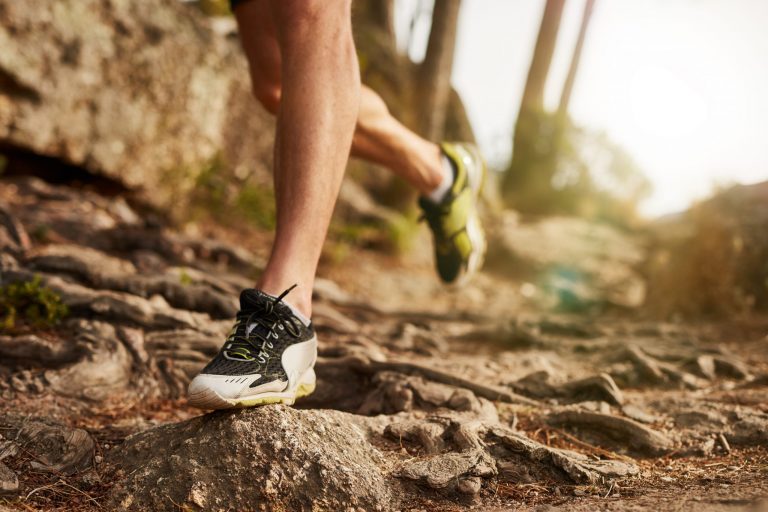
Trail runners have a physically demanding terrain. Trails are often bumpy with unexpected hills and branches to navigate. Since many nature trails involve hiking at an incline, this can mean that muscle strengthening comes from additional exercise.
Strength training is physically demanding on the entire body. While leg strength is obviously used to propel a runner forward, arm and core strength is used for balance. Before running through trails, additional muscle strengthening is recommended for beginners.
What Kinds of Roads and Trails Are Best For Beginners?
Running on a road is a high-impact activity. Hard surfaces can eventually cause muscle aches, especially around the knees.
In addition to running on pavement, blacktop with a slightly spongy element to the surface can help the body grow accustomed to running. Runners that prefer hard surfaces can also run indoors. Treadmills and indoor tracks are both used for marathon training.
Trails can greatly vary in difficulty. Choosing a trail solely for the purpose of beauty is not recommended for beginners. When just starting out, runners may need a shorter distance with less of an incline. Trails that lead up steep hills or mountains can be damaging to untrained muscles.
The Benefits of Running
Both types of running have several health benefits that can improve breathing quality and muscle tone. Some of these benefits include bone density, weight loss and cardiovascular health.
In addition to running, jogging also has health benefits. By jogging on a regular basis, the lungs and heart become stronger. While knee issues can occur without a proper warm-up session, jogging and running can help decrease the risk of arthritis.
In addition to the physical health benefits, running can also increase mood. Anxiety, depression and stress can be reduced with physical activity. Since running is an activity that can be done alone, this also increases the likelihood for daydreaming and meditation while exercising. Even running as a hobby can help people feel energized throughout the day.
Running can help prevent high blood pressure, stroke, vision loss and heart attacks when done on a regular basis. Even though medication can help with some of these health issues, running is a natural way to improve the body without side effects. By living a healthy lifestyle, the body can run stronger and longer than ever before.